What makes a wok truly EXCEPTIONAL?
What defines a great wok, and how is it actually made? In this article, we take a deep dive into the art of hand-forging to show you what goes on behind the scenes at Mammafong. We’ll explore the unique surface of these woks and why those details change everything when you start cooking.
It’s a distinction worth making. While the market is flooded with cheaper alternatives, those budget options usually share nothing but a shape. To help you understand the difference, we’ve broken down the key factors that define the cooking experience:
- Hand-forged vs. “aesthetic” hammering: Is it built for performance or just for show?
- Forged steel vs. pressed sheet metal: Why the soul of the metal matters.
- A “pot” vs. your “Favorite kitchen tool”: What creates that lasting bond?
Hand-Forging vs. Decorative Hammering
Authentic hand-forging doesn’t always mean a rugged, “rustic” look. You’ve likely seen woks boasting “3,000 hammer marks” on the surface—while these can be beautiful (and expensive), that heavy dimpling is often purely aesthetic. In many cases, the wok is finished first, and the patterns are hammered in last just for visual appeal.
(This picture shows a rustic wok priced at €350. It’s a beauty!)

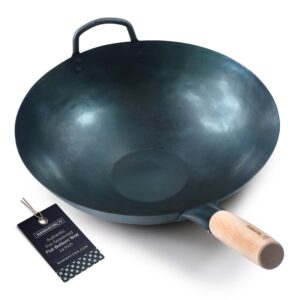
At Mammafong, the hammering serves a functional purpose. The hand-forging process is used to shape the vessel and compress the steel for density. Afterward, the surface is smoothed and leveled. While you might not see deep hammer marks with the naked eye, the microscopic surface structure is exactly what you need. This subtle texture allows ingredients to “grip” the sides of the wok when pushed up the walls—a fundamental requirement for authentic stir-fry technique.

Forged Steel vs. Pressed Sheets
The difference lies in the molecular structure. During forging, the grain of the steel becomes finer and more homogenous, resulting in superior strength and lifespan. Mass-produced, pressed woks simply don’t undergo this structural transformation.
Wall thickness is the other “make or break” factor. You need a perfect balance between heat retention, responsiveness, and durability. Drawing on generations of Asian manufacturing expertise, the “sweet spot” is 1.5mm to 1.6mm. This is why Mammafong woks are crafted with 16-gauge (1.5mm) carbon steel. This specific thickness ensures the wok heats evenly, feels solid in the hand (without “resonating” or vibrating), and maintains its shape under high heat.
The Myth of the “Perfectly Flat” Bottom
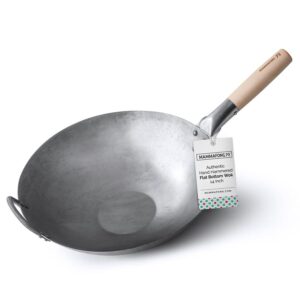
Because they are handcrafted, Mammafong flat-bottom woks aren’t “table-top” smooth—and that’s by design. The bottom actually features a very slight inward curve. As the steel expands under intense heat, it levels out to become stable on your stovetop. A wok that is dead-flat when cold would actually become problematic and unstable once it hits the flames.
Why Not Just Buy a “Budget” Wok?
We often get asked how our woks compare to the ultra-cheap options found on mass-market platforms like Temu. The reality is that those products are typically made from much thinner material using cost-optimized industrial pressing. We’ve even seen cases where the wall thickness was inconsistent throughout the pan.
A Mammafong wok is a serious piece of equipment. It is made from 1.5mm thick, compressed carbon steel designed for years of intensive use. You can feel the quality the moment you pick it up:
35 cm Wok: approx. 1.5 kg
30 cm Wok: approx. 1.25 kg
These specs aren’t just numbers—they translate to better heat distribution, faster thermal response, and a lifetime of durability.
At the end of the day, we’ve handled and tested countless woks over the years. We know that the real difference isn’t found in a photo—it’s found over the fire. If you are looking for a genuine wok experience rather than just an “Asian-style frying pan,” this tool will be your companion in the kitchen for a decade to come.
(n this photo, you can see a Mammafong wok that’s been in active use for 5 years.)